Marketing agency fees in the AI era should change dramatically. AI and automation are eliminating large amounts of execution work while increasing the value of strategy, judgment, governance, and outcomes.
This transformation applies across Media, Creative, Performance, Brand, Measurement, CRM/Lifecycle, Advocacy, Auditing, AI, and combinations of them all.
All types: Media. Creative. Performance. Brand. Measurement. CRM/”Lifecycle.” Advocacy. Auditing. AI. Combo of all.
Three strategic drivers behind the ‘we’re not in Kansas anymore’ realization:
- AI achieved broader, more general intelligence.
- Ad platforms happen to own foundational AI models. Translation: Intelligence became available, automated, and actually useful FAST.
- Interconnectedness of systems. Data moves in real-time across your stack, platforms, partners, everyone. That doesn’t make AI smarter in general. It makes AI smarter about you.
These delicious drivers of behind the scenes changes at Agencies are now ready for a cascade of benefits for Clients.
More, For Less. Really!
Immediate and medium-term implications:
A. In my model, the reduction in work currently listed in your Agency SOW could translate into a 25% – 75% savings in Agency fees, starting July 2026. For all types of Agencies listed above.
B. New work currently underpowered or unlisted in your Agency contract will translate into a 15% – 25% increase in Agency fees.
A+B will save money AND deliver materially better business outcomes AND make change-embracing Agencies indispensable deep partners.
C. Previous TMAI editions have shared the scale of change in Performance Marketing. These contracts will shrink 75% – 80% re work/fees. I’ve also shared the increased strategic importance of Brand Marketing. These contracts will shrink 25% – 40% (due to A), while overall budget will likely go up, possibly a lot (due to B).
[Premium Subscribers: Please dive back into TMAI #496: What The Heck is Brand Marketing – the implications will power the next 10 years of your career. Email me if you can’t find it.]
Change will happen on sliding scale. Ex: Everyone can get A-driven 25% to 35% savings from work elimination today. Achieve about the same reduction next year – at that time you might also add 10% B-driven. So on, and so forth.
Cut to Grow. Really?
My objective is not to save on Agency fees. It is to create incentives to fully embrace the present and be ready for an unknown future.
If your Agency is working off an old-world Statement of Work (SOW), all the incentives, legally, aligned to keeping the past as the future.
Current contract has no incentive to shift work to platform intelligence and automation – thus reducing Agency hours. The SOW rewards manual work: micro-optimization, reporting, complex campaign setup, etc. – all harmful to AI-led efforts. Your contract’s Percent of Media Spend rewards spending. More and more and more activity – easier via non-AI! Paying using KPI Percent of Outcome creates AI-Impact alignment – it is not in the contract.
Renegotiate your Agency contract not to save money.
Do it to:
A. Align Agency’s incentives to embrace AI and Agentic everything, codify doing less can be more by paying big for Outcomes.
B. Incent the Agency to invest in building skills in areas AI and you can’t solve for (more on this below).
C. Add new big fee line items for items critical today and existential in 2027.
Critical lens on Agency fees is simply a mechanism to accomplish A, B, C.
When you renegotiate, you are not buying fewer hours of the same old work. You are buying a different operating model.
A Gigantic Caution.
Nothing I’m recommending will actually work while the Agency fees are a Percent of Media Spend.
That model literally pays the Agency to touch more, spend more, and be anti-AI.
To make the present the future, your Agency contract structure needs to migrate to:
1. A lean base retainer for governance + steering + data engineering. Approx. 40%-50% of the new, smaller total.
2. Project fees for creative concepts & pre-testing, complex strategic analytics (not “measurement” or “reporting”), and portfolio strategy. Approx. 30% – 40%.
3. An outcome incentive tied to incremental profit (or at least incremental revenue, verified lift, and NEVER platform ROAS). Approx. 15%-25%.
The Agency will now offer genuine specialist depth, cross-client learnings that power speed of innovation, cross-platform OEP consumer behavior informed strategy creation, and new outside-in scale… Or additional fees reductions become possible.
Everybody Wins, YES!
If you lead an Agency, I’ve likely added to your discomfort. Let me make the case for why this change is incredibly exciting for Agencies.
A. You are no longer a hamster furiously rotating a wheel connected to nothing.
Agency gets to work on really cool, smart, high-value, unquestionably outcome-impacting initiatives. This extends the life of the Agency. This enriches the careers of every Agency employee.
B. You don’t need to be doing $50/hr or $100/hr work.
Your new SOW contains more expensive $500/hr and $1,000/hr work streams, along with $yyy,yyy per week costing strategic projects!
Glorious impact: This new and exciting work allows you to hire large numbers of entirely different types of experienced individuals – while paying them well (vs. the current: charge the client a lot, hire the most junior employees you can get away with, and pay them below market wages in exchange for “experience”).
C. (As with every revolution…) Better Agencies will emerge.
Agencies have died and were born each day last decade. I anticipate both accelerating in the next two years.
Births will be so exciting. Modern Agencies attuned to persuasion in an AI world, responsive to shifting consumer experience, embracing/leading radical evolution of platforms, structurally built to be outcomes-centered strategic partners! Mamma mia!!
The Core Shift.
The old Agency fee was largely rent on an execution army: campaign builds, keyword lists, audience segmentation, manual bidding, painful upfront contract negotiations for the next 18 months, pacing, trafficking, QA, reporting, and constant “micro-optimization” on ad platform to feed Clients with the illusion of “work” – and have something to show in the 2x/wk meetings Client employees demanded to “prove value.”
Except for the illusion need, most levers above are pulled by the platform’s own AI for Performance Marketing and many for Brand Marketing. You’ve heard the names: Smart+, ASC, PMax, AI Max, yada, yada, yada.
[Premium Subscribers: Calculate your sophistication score: TMAI #508: Google Ads Maturity Model. +Discover what your Agency should have been doing mid-2025 onwards.]
An Agency’s value has migrated upstream: Cross-platform OEP consumer behavior informed strategy creation. Value signals hunting and automation. Creative concept ideation and pre-testing (execution and variations are AI helped or solved). Super advanced holistic full-anywhere-outcomes analytics. Governance (guardrails, Agentic wrangling, brand safety). Some or all of these create new client impact and new client fees.
The Agency should not be paid primarily for touching the account.* In fact, over-touching now actively degrades algorithmic performance by messing up AI learning!
The Agency should be paid for automation, more senior judgment, governance, scaling intelligence, and bleeding edge innovation risk reduction (not “A/B Experimentation”).
Agencies are not becoming worthless. The basis of their value is materially changing.
Exactly as, Analysts / Creative Directors / Content Creators are not becoming worthless. The basis of their value is materially changing.
* If in July 2026 your Agency is touching your account more than once every dozen or so days, do not blame them… Fix the source by firing your Marketing Manager & Director.
Subtractions & Additions to Power Your Shift.
As someone with leadership roles at Clients (15+ years), Ad Platforms (15+ years), working closely with Agencies (10+) and leading one (2+), I say with confidence that the future is super bright for Agencies with good CEOs.
To support that transformation, presenting my… Client < > Agency Operating Model.
This week: Subtractions. Everything transitioned to Platform AI or reduced or eliminated entirely, resulting in changed Agency scope and resulting contract savings.
Next week’s Premium edition: Additions. A. Everything your team should own now. B. Streams of higher value work the Agency needs to grow into and be paid more.
Subtractions: What You Stop Paying For.
Extracting from a typical past Agency contract, the subtractions contain twelve dimensions to focus on. For each, I’ve identified the typical cost weight, reduction in Agency effort, and contract savings.
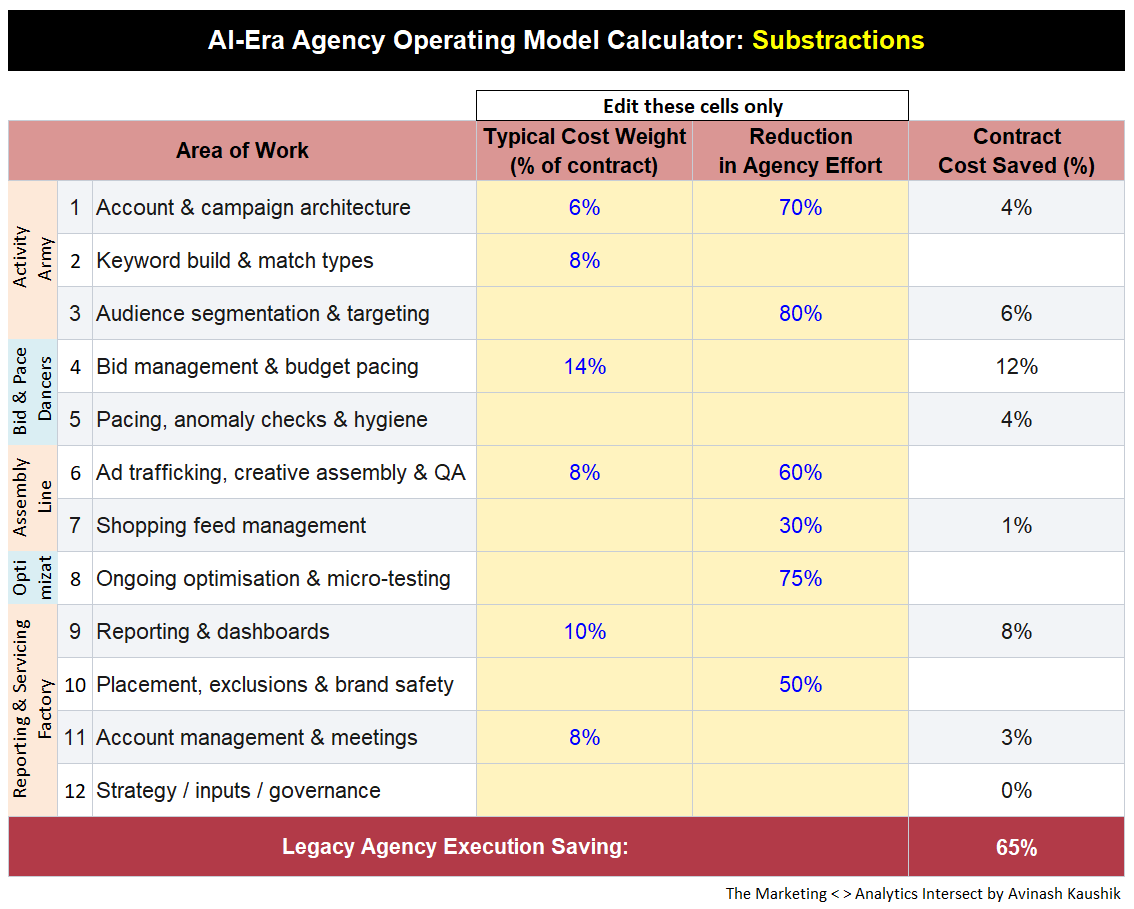
For each of the 12 dimensions, in a robust spreadsheet, I’ve identified: Area of Work. Old Model (what an agency did). New Model (powered by platform AI). New Company Role. New Agency Role. Change in Agency Scope. Estimated Contract Savings.
Since my experience along all of these dimensions would take a mini-book to detail, I’ll compress 12 dimensions into 5 clusters and summarize your actions.
[Note: TMAI Premium subscribers can reach out for the robust spreadsheet to direct the conversation with their Senior Leadership, Procurement, and CFO.]
1. Agency Activity Army.
Account and campaign architecture, “keyword” research and match-type sculpting, audience segmentation and targeting, radio & tv ad tactic structures. This was the beautiful old world of a hundred thinly sliced campaigns “for control.”
The machines devoured this work. PMax, Advantage+ (A+), similar collapse structure into a few asset groups that the algorithm allocates internally. Intelligence reads intent, using additional tens of thousands of data points beyond the keyword or post content. A+ audiences treat your segments as hints, and then finds converts you never listed.
The Agency’s job is not building, it is deciding. Advertiser (you) sets the reward function hierarchy, brand/non-brand priorities, brand safety red lines, margin protection bands. The Agency’s real remaining role: One-time architecture design, and occasional restructure IF strategy changes. It is NOT monthly rebuild billed as progress.
Approx. 22% contract cost weight, work that can be reduced by approx. 78%.
2. The Bid & Pace Dancers.
Manual bids, budget adjustments, day parting, device modifiers, daily pacing, spend checks, disapproval fixes, “anomaly” checks, “hygiene.” Hours and hours and hours.
AI can do narrow intelligence at a scale and impact that surpassed us in late 2024.
Smart bidding to your reward function (see: TMAI #432: AI Unlock: Value Based Bidding), campaign budget optimization, automated alerts, auto-recovery, now all this work continuously, and better. You just need to let the AI learn. When it starts, results will dip a bit. Your Agency jumps in to rescue by cutting bids/something. The AI learning resets. The dip returns. Agency… You know the rest. No stable learning. Company keeps sucking.
Reminder: Over-touching does immense damage in an AI world. Your Agency is causing this harm and it is your fault – for not understanding that every “rescue” is a sabotage.
The Agency job shrinks to setting the true reward function (aka kpi, target), occasional configuration of guardrails IF business strategy changes, and, hardest of all, operate at the rhythm of the AI’s learning cycle.
Approx. 14% contract cost weight, work that can be reduced by approx. 73%.
3. The Assembly Line.
Trafficking, ad builds, combination making, ad formats \/ creatives \/ variations, torture of tagging, QA, shopping-feed babysitting.
Ad platforms – except TV, Radio, press – can do this at a scale AND relevance that will shock you. Assembling bits from your ads, text, site, building creative, generating variants with GenAI (try this on paid Amazon!) mixing image video audio in the best version per person. All they need: often just your site link (or core assets) and a reward function.
Note: One reason they can do this spectacularly well is that your creative is judged by your VP of Creative/HiPPO, while the creative Ad Platforms deliver is judged by the business outcome delivered. 🤯
The Agency’s role narrows to the genuinely useful: Asset preparation, clean taxonomy, and spot-QA. Feed management is the one line that remains meaningfully skilled for now – sadly, data quality is still human.
Approx. 12% contract cost weight, work that can be reduced by approx. 45%.
4. The Optimization Theater.
Daily rituals of pausing “losers,” shifting budgets by feel, endless small A/B tweaks, the deeply irritating unfocused “learning agenda” items that will never amount to much.
Often the single biggest cost, and now the most destructive thing your agency is doing.
Modern AI-led platforms run their own continuous explore-exploit; they are already testing combos of creatives, bids, targeting to find high-value customers – at scale and cray cray speeds. They can also account for learning cycles that can span weeks/months, try that with a human.
The Agency’s role is cut down to: Few, really big (as in 15%+ increase in revenue), clean experiments, with the right altitude (creative concept – not execution -, audience attribute).
Approx. 16% contract cost weight, work that can be reduced by approx. 75%.
[Premium Subscribers: The role of what an Analyst does is quickly changing. Your current role will be gone by Jan 2028, replaced by a better one. If you are willing to learn and change, here’s how to save your career: TMAI #495: Analyst 2028: S.H.I.F.T For Relevance.]
5. The Reporting & Servicing Factory.
Manually pulled weekly decks/spreadsheets/update emails. 2x Weekly “update” “check-ins” with 6-36 Agency attendees. Exhaustive reports on placements and “brand safety.” Agency “account management” meetings with other vendors and partners. Detailed hand written commentary of the data already in dashboards. Urgent need it by EOD cuts of existing decks/reports. “Client Training Sessions,” with content already easily available to all anyway. Dinners, outings, offsites, to ensure client happiness.
AI cannot solve for all these items, certainly not dinners and outings.
But, dashboards and reports are disappearing with Claude-fronted data lakes that can do both what and why to such a great extent that you don’t have to be held hostage by the Agency’s 17-tab spreadsheet. Platforms for automated placement filters, and brand safety tooling that gets better by the hour. Since there is ever increasing automation in Meta and Google, you need drastically less “account management,” and certainly not as many meetings.
The Agency’s work is limited to: Aforementioned dinners. Automating in-flight optimization. Shifting focus from Care (99% today) to Do & Impact (TMAI #391: Data Storytelling Framework: Care, Do, Impact).
Approx. 30% contract cost weight, work that can be reduced by approx. 60%.
Punchline: Contract Cost Weight * Reduction in Work and in my case equals 65% savings. For you, it might be a little less or a little more. Use the table and the math above to discover.
The work is not going away, a lot of it is moving to machines. What’s left is more useful, higher impact work. Agencies don’t sell motion anymore. They sell judgement.
The Conversation Continues in Part 2.
Achieving this transformation in our Agentic AI-era requires you add new roles to your company to thrive in this new universe.
You also need to add/increase SEVEN threads of new work to your Agency contract.
In Part 2, I’ve covered both these critical elements in detail. Additionally, it also contains the complete Operating Model in Excel, to simplify transformation conversations with your CMO, CFO, VP Procurement… And then, your Agency.
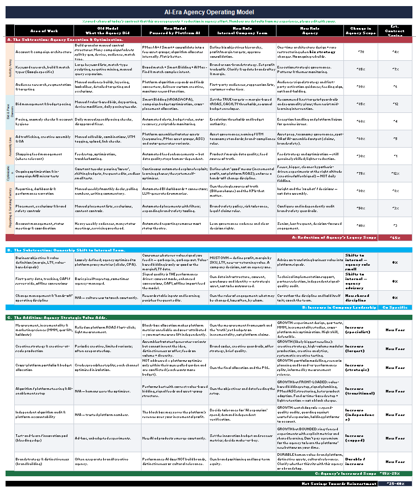
If you are a TMAI Premium subscriber, please reach out for Part 2 if you are unable to locate it in your inbox.
Bottom line.
I come to Agencies from a place of respect. The best ones are extraordinary – taste, courage, and pattern memory across dozens of clients that no in-house team can match.
I come to AI from a place of trust. A vast majority of performance execution is AI-led, and all of it will be soon enough.
That respect and trust sit with this pragmatic truth: You can pay for the past or you can embrace and extend the present.
A new tomorrow starts with knowledge, and now you have it.
Carpe diem.
PS: A little in the weeds but…
A. With the extraordinary criticality of data and automation, it is important that you own your ad accounts, pixels, and any data Agency is piping from sources beyond you. Avoid becoming a hostage or victim. Get immediate and complete ownership.
B. When you kill Percent of Media Spend, you are putting a kibosh on toxicity of undisclosed markups, principal media, and rebates. Awesome. Be aware: There may be people inside your own company for whom that toxicity is a positive incentive. Don’t forget to fix it.