
In a world with fuel-efficient long-range motorcycles, do you insist on using horses for transportation?
I’m of course talking about the Google Ads platform. To help you assess whether your company is actually AI-ready, I built a Google Ads maturity model that scores both your capability and how widely that capability is deployed.
Like it or not, Google has been AIfying their platform for some time. [Meta as well.] They are making it harder and harder for us to stay with how it used to be. Not such a bad thing, because to achieve better outcomes we can do less and the AI can do more.
Hence, I admit to immense frustration when in meetings and online discussions, “Search marketing” is still framed as brand, non-brand. Search “Marketers” are still monkeying with match types, hours, geos, audiences, negatives, and all the rest. Search “Agencies” are still proving their worth by making changes multiple times a day. All this is going backwards, profit pulverizing.
☹️
I want to share two biases:
1. I spent 16 years at Google. I worked on projects with the Product and Engineering teams – one of which won our team the rare Google Founders Award. Through my work, I come to Google from a place of trust. Sure, Google & Googlers make mistakes and doozy decisions at times. Most are explained by Hanlon’s Razor.
2. I come to AI from a place of trust. I believe the vast majority (all of Performance) will be powered by AI. Hence, I believe the optimal strategy is embrace and extend. Sure, AI makes mistakes and doozy decisions. But it learns, it improves, every day!
You might come to Google and AI from a different place. I respect that. In a business context, consider this pragmatic perspective: The choice to stay in the past is not available.
So… Why lose our employer cash every single hour? Why put your career in reverse gear? Let’s embrace the possibilities today and extend our winning streak!
Current AI Offerings in Google Ads.
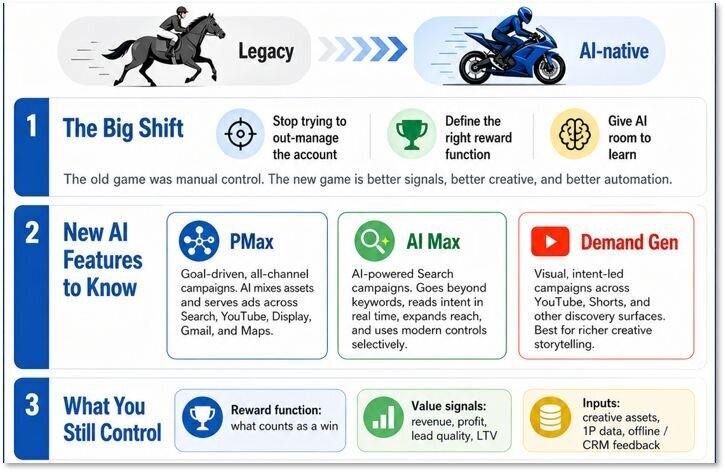
Google’s “let us do everything for you everywhere” campaign is called PMax. Give Google your goals, a budget, a bunch of assets (text, images, videos, logos), and Google’s AI then mixes and matches these assets to deliver ads across Search, YouTube, Display sites, Gmail & Maps.
Google’s AI-powered Search-only campaign is called AI Max. No concept of brand, non-brand, match type, etc. AI Max assesses intent in real time and promises to deliver your ads to highly relevant search queries. The key bit: It looks beyond search keywords typed, and analyzes intent to expand your audience.
Demand Gen is a visual option (aka ex-Discovery ads) that uses AI to assess intent and deliver your video ads, Shorts, and other ads.
Two things are happening with all three: A. You control the “reward function.” AKA: What winning means for you. B. AI assesses intent across a significantly wider set of signals than you and I can imagine.
PMax, AI Max, and Demand Gen are not perfect yet. Still, as applications of narrow AI, they are already better than us humans, and getting better every day. Losing three or four times while winning thirty or forty times is a decent tradeoff.
Maturity Assessment Killer Parameters.
Are you truly living in the AI present, or are you a tourist in the present?
To help you do a genuine assessment of horse riding or motorcycle riding, I’ve built a simple maturity model. The self-reflection is powered by two dimensions.
Capability Scoring: How sophisticated are we?
You’ll score your company on a 0–4 scale in each dimension.
0 = Legacy.
1 = Mostly legacy with some automation.
2 = Hybrid.
3 = Modern.
4 = AI-native.
Depth Scoring: How widespread is our sophistication?
I’ve included this to help prevent self-deception. We will use relevant spend / conversions / campaigns to assess how widespread.
0 = None.
1 = Pilot only, under 10%.
2 = Partial, 10–39%.
3 = Scaled, 40–74%.
4 = Execution default, 75–100%.
To prevent self-deception, I recommend:
- If your depth is 0 or 1, capability cannot score above 2. Admit you are not really there yet.
- If depth is 2, capability cannot score above 3.
- Only depth of 3 or 4 can earn a capability 4.
My model will score your maturity in two steps:
Step 1: Dimension Score = Weight x (Capability/4) x (Depth/4)
Step 2: Company Maturity Score = Sum of Six Dimension Scores.
Your destination? A score of 85 or higher.
Google Ads Maturity Model | Six Dimensions.
Our objective: Nearly all business outcomes are optimized by Google, using automated modern intent <> value signals.
The Google Ads ecosystem is complex enough, diverse enough, that you can take many different approaches. Mine is clustered and prioritized based on my experience and what I see a couple years out. Here are my six dimensions:
1. Measurement & Value Architecture.
Weight: 30 Points!
Because: If you don’t know where you are going, any road will take you there – and you’ll be miserable at the destination.
Google’s intelligence and automation can only optimize to the signals (reward function details) it receives. Enhanced conversions improve measurement and unlock stronger bidding; data-driven attribution is the default for most conversion actions; value-based bidding is explicitly about maximizing conversion value such as revenue, profit, or lead score; and Data Manager is now Google’s central layer for activating 1P and offline data.
The one thing you still control is the reward function – what the AI should deliver that’s of value to you. Hence, if your measurement and value architecture is weak, everything above it is built on sand.
> > How to score Capability?
0: Your team is optimizing for lame proxies such as pageviews, sessions, basic leads, or “all conversions.” No enhanced conversions. No offline data.
1: Basic online conversion tracking exists, but it still treats every lead or sale as equal.
2: Macro conversions are cleaner, enhanced conversions are live, but value is still crude or incomplete.
3: Revenue or lead-quality values are passed back to Google. Offline conversion imports or CRM feedback exist. DDA is in place.
4: Bidding is driven by true biz value: Revenue, profit, closed-won value, predicted LTV, etc.
Score from 0 to 4, see legend above.
Horse rider tell: “We trust automation, but we still optimize for traffic.”
Motorcycle rider tell: “We let automation optimize to our reward function of what a good customer is.”
> > How to score Depth?
Truth Question: What percentage of business outcomes from Google are measured by modern value signals?
Evaluate depth using share of conversion value or lead volume covered by modern measurement:
% of macro conversions using enhanced conversions.
% of conversions tied to value (ex: revenue, LTV).
% of leads/sales with offline or CRM feedback loop.
0 to 4, see legend above.
Great News: In TMAI #508, I’ve shared my maturity assessment as a working Excel model. Once you punch in your Capability and Depth scores, it will provide a personalized set of actions to bring your company into the Ads intelligence and automation age! If you are a TMAI Premium subscriber, please email me for it.
> > Actions to arrive at the present?
For the measurement and value architecture my model will select from:
1. Fix primary conversion actions.
2. Enable enhanced conversions.
3. Import offline or CRM outcomes.
4. Move from volume-based bidding to value-based bidding.
A company can have good creative, tidy campaigns, PMax, Demand Gen, and pretty reporting, but still be immature if it is optimizing for the wrong outcome.
2. Search Operating Model.
Weight: 20 points.
The present, riding motorcycles, is about smart bidding, broad match, responsive search ads, and your coverage depth at 100% for AI Max! It is giving up the need to segment by match type, manual bid adjustments (god no!), and human text customization. It includes automated search term matching, final url expansion, and some new controls like brand controls (use them!) and location-of-interest.
> > How to score Capability?
0: Manual CPC, heavy device/hour/day bid modifiers, exact-match obsession, SKAG-era structure.
1: Smart Bidding exists, but you’re excessively slicing campaigns by match type, device, or tiny keyword themes.
2: Responsive search ads and some Smart Bidding are live, but the account still reflects a control-first mindset.
3: Core non-brand search uses Smart Bidding with broader matching logic, and, important, RSA-led creative.
4: The team is all-in on AI Max, and uses controls selectively for governance, not for micromanagement.
Score from 0 to 4, see legend above.
Horse rider tell: “We still believe performance comes from sculpting the account harder.”
Motorcycle rider tell: “We’ve simplified the structure and given the system room to learn. We use controls sparingly, primarily to protect the brand.”
> > How to score Depth?
Truth Question: What percent of our non-brand search budget is still being run with an AdWords-era control mindset?
The search operating model is critical because the most desirable biz outcome: SCALE!
Evaluate depth using share of non-brand search spend.
% of non-brand search spend on Smart Bidding.
% of non-brand search using broad / modern matching approach.
% of eligible search campaigns using AI Max.
To simplify, you can use AI Max row, because it covers broad customer intent matching (beyond KWs), creative optimization, and final URL expansion.
0 to 4, see legend above.
> > Actions to arrive at the present?
Based on your score above… To win, my model will identify your personalized actions from:
1. Migrate key campaigns to Smart Bidding.
2. Stop relying on manual bid modifiers for performance steering.
3. Broaden match philosophy on non-brand.
4. Test AI Max where available rather than assuming old keyword logic is still the ceiling.
At the end of this stage, we erase the fantasy that humans can out-manage auction-by-auction intent better than Google’s AI.
The Journey Continues!
The Google Ads maturity model contains four additional dimensions:
3. 1P Data & Audience Intelligence. How effectively are you connecting high-quality first-party customer signals to Google’s intelligence?
4. Surface Breadth & Campaign Mix. Are you using the full range of Google surfaces based on customer intent rather than legacy channel habits?
5. Creative & Landing Page Adaptability. Are you giving AI enough diverse, high-quality creative and destination experiences to match intent effectively?
6. Operating Cadence & Governance. Has your team shifted from constant manual intervention to intelligent guardrails, learning cycles, and business-outcome governance?
These dimensions help you out-smart your competition – while your competition tries out-spend you! TMAI Premium #508 contains the complete scoring logic and automated model for all six dimensions.
TMAI Premium subscribers can simply email me if they can’t find TMAI #508, or would like the automated Excel model to identify if you are a Legacy AdWords Operator (score: 0 – 29) or a Modern Google Ads Advertiser (70 – 84), or… are you the unicorn at 85 – 100!

Tips to Avoid Self-Deception Scoring.
This is not an exercise to convince your CMO that you are an 86. Fooling is not progress. Do a real assessment, even if you keep the scores to yourself.
To ensure zero self-deception I recommend:
A. Score Depth before Capability. It ensures your ego won’t hijack the room.
B. Audit the top 80% of your Google spend. Don’t let edge cases and pilots distort the truth.
The truth will set you free. 😍
Bottom line.
The old game was: Can the human out-manage the account?
The new game is: Can the company feed the machine better truth, better creative assets, better customer value signals, and give it enough room to learn?
The cultural pain of learning the new game is worth it because, depending on your current maturity score…. 3x, 5x, 20x Revenue and Profits await.
Not to mention how much more fun it is to give up the soul-sucking work of the AdWords world. Scores above 69 make work meaningful, even joyous.
Carpe diem.














1 thought on “AI Ready? Google Ads Maturity Model.”
The choice to stay in the past is not available.
This is the wake-up call a lot of search agencies need right now. The job is no longer twisting the dials; it’s building the data architecture and creative assets that allow the AI to win for you. Brilliant framework!