
 We love our conversion rates. :) Really really.
Part of me is glad because my book and the Trinity strategy and the Web Analytics 2.0 mindset all stress the importance of measuring Outcomes.
No Outcomes = No Happiness.
But I have come to realize that we are not being the best we can be by focusing on just the overall website conversion rate. We are leaving money on the table. We are not getting enough credit. We are not getting a good understanding of the complete picture. We are being short sighted.
Regardless of why your website exists it is quite likely that there is a rich diversity in reasons why people come to your website (hence the core pitch to understanding Primary Purpose using 4Q: The Best Free Online Survey For A Website). Conversion being just one of them (“please please let me in, I want to be converted!!”).
What about those who refuse to be converted online?
You worked hard (hopefully!) to get them to the site, if they did not convert did you accomplish nothing?
Hence my recommendation:
Let me explain.
This “picture” represents a typical website and measurement of it’s success, what’s the word I am looking for. . . . oh conversions. . . . : )
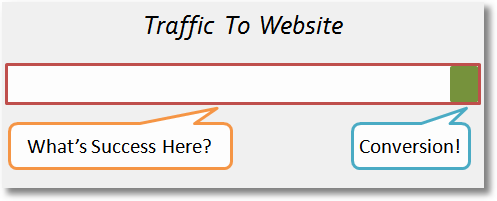
You have your two percent conversion rate (though just to be generous I am probably showing a number much higher than that above). You should be happy, atleast you are up to some benchmarks in that space.
But what do you do in terms of measuring complete success of your website? All that white “space” (Unique Visitors) wasted for nothing?
No. Well maybe some.
But people don’t just come to your site to Buy. They are there to Research products and services (and buy offline). They are looking to get Support. They are there for looking for Jobs. They might be there to look at your latest Blog Post, etc.
Make each one of those your Micro Conversions. Identify what they should be using 4Q and then using your Web Analytics tools to measure success.
Here’s your new, and I might add complete, measurement of success. . . .
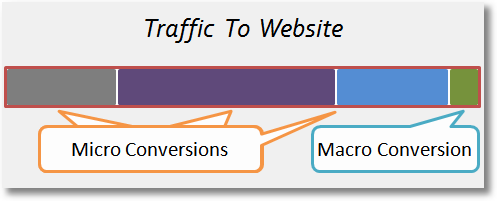
Nothing wasted, every activity on the site measured for success in some small or big way.
Here’s a view that might apply for your ecommerce website. . . .

For the macro conversion you measure Outcomes (say orders, see this post for definitions: Conversion Rate Basics & Best Practices). For micro conversions you could measure page views and job applications submitted and number of times the Print This Page was clicked (the hypothesis being you’ll buy in a store or something like that) or Task Completion Rates by Primary Purpose for Support, Research & Careers from your website onexit survey.
Either way you have just provided your management team with a complete picture of your website’s success. And you have shown that you are brilliant because you are measuring success of all visitors on your website. Priceless.
Have you clearly identified what the micro conversions are on your website?

Benefits of measuring micro-conversions:
- You’ll focus on more can just the main reason the site was created.
- You’ll measure multi-channel impact, well beyond your website. Most people don’t get budgets for web analytics because all they are focused on is measuring what happens during a small % of visits. Expand and conquer.
- It will force you to understand the multiple persona’s on your website, trust me that in of itself is worth a million bucks. It will encourage you to segment (my favorite activity) visitors and visits and behavior and outcomes. Success will be yours.
- You’ll realize the limits of a pure clickstream strategy and you’ll be forced to expand beyond just Google Analytics or Omniture or CoreMetrics etc and execute a true Multiplicity strategy, that is good for your company and it is good for your career.
- You’ll be happy. Most people who do web analytics are sad and/or frustrated. One of reasons for it is because they are hyper focused on a small part with way more data than they can ever churn through.
By expanding your measurement horizon and seeking insights from a broader area means you’ll know what to do with all this data. Which means you’ll smile a lot more, because you’ll feel a sense of accomplishment from your job. Happiness is good.
Convinced?
Ready to execute?
Let me share some stories to spark ideas in your mind about how to identify your own complete conversion rate picture.
Photo publishing and sharing website:
When www.fotonatura.org, an awesome Spanish photo sharing website (check out: Calopteryx splendens!) wants to track success they measure Conversion Rate. . . .

They are doing very well. Fernando is quite happy with how is project is performing. But he is also very smart and he is measuring micro conversions, things that his site is trying to do that mean success for him. . . .

His micro conversions. . .
1. Registrations on the site.
2. People / Members publishing photos (core for growth).
3. (I think, my Spanish is bad!) People who sign up for premium content.
4. (I think) People who sign up for newsletters / announcements (good for future customers).
A complete picture measuring all types of behavior and all elements of success. The 1.72% conversion won’t go up waaay high, but the site’s success is bigger than just that one number. Above picture is how you measure that.
Makes sense right?
A quick note: Your micro conversions don’t have to lead up to the macro conversion (though in this case they kind of do). In our very first example of ecommerce website notice that the micro conversions are very different from the macro, they are just subservient, a little bit, to the macro.
Tech Support Website:
(These ideas are from one of my posts: Measuring Success for a Support Website.)
Macro Conversion:
Task Completion Rate (measured by surveys, true customer centricity baby!).
Micro Conversions:
1. “Call Avoidance”: Number of Visitors who see the Phone Number page (hypothesis: all other things being equal if the site is good this number goes down over time).
2. Content Consumption: Visits over time to each technical support core area (maybe different products or types of problems etc).
3. Tickets Opened: # of technical supports tickets opened on the website (and over time compared to those opened over the phone).
4. Sales: Revenue from referrals from the tech support site to the ecommerce site (sometimes the best solution to fix a problem is to buy the latest version of the product, or a upgrade!).
5. Net Promoters (“Likelihood to Recommend”): The % of people (or a indexed representation) who will recommend the company products after a experience on the tech support site.
Again the stress is on understanding the overall purpose, get people answers to their questions hyper fast, and also the other smaller things that the site might be impacting.
Who knew this thing was so much fun? :)
Another Ecommerce Website:
We have already covered ecommerce in the very first example but I wanted to share this one as well because it was so nicely created for this concept. . . .

Very self explanatory, covers all the reason the site exists beyond simple taking orders / transactions.
[Update: If you would like to learn how to identify goal values, the economic value, of each of the micro-conversions above, please see this post: Excellent Analytics Tips #19: Identify Website Goal [Economic] Values]
Social Media Metrics / Blog Success:
Social media sites are tricky because many traditional analytics tools and mindset fail at identify first what to measure and then at data capture. At the moment there are not set tools and perfect answers. For blogs I have made an attempt at creating metrics to measure holistic success.
The “macro-conversion” I use, and recommend, is RSS Subscribers, or more specifically growth of RSS Subscribers. The hardest thing to do in an attention economy is to get permission to push content, RSS represents that permission to me.
I track RSS using FeedBurner:

Of course it would be silly to get hung up on a point in time and obsess about daily up and down, so I actually track growth in Feed Subscribers over time (month to month):

Macro Conversion: Net Subscribers Added.
When it comes to micro conversions things get a bit more delightful. . . .
Clicks on the book’s link to Amazon:

Ok so I have to put that into excel and actually compute the % between the red and the green, but you get my point. It is a “conversion” if people click on link and perhaps go buy a book (it is especially nice because 100% of my proceeds from the book are donated to charity!).
Since the link as a affiliate code in the link I can track conversions at Amazon’s website using their affiliate reports.
Conversation Rate:

The number of user comments per post, trended over time. It represents the success at engaging visitors with your unique content and getting them to contribute their thoughts, i.e. in the most social of social environments your ability to create meaningful conversation.
For the last 30 days this number stands at approximately 30, a bit higher than my goal.
(Thanks to my good friend Joost for the Blog Metrics plugin!)
Ripple Index:

The number of unique blogs that link to your blog (with links expiring in in six months to ensure you keep creating content that causes a “ripple”). I use Technorati to measure this.
In the above image that number is 1,163. Your, or my, ability to influence others and create conversation in the ecosystem.
There is another interesting thing the above example of blog illustrates, something you can apply to your own success measurement of any type of site: Sometimes you have to go beyond just the tools you have, and other times you have to create new metrics to measure micro conversions. That’s ok.
Macro + Micro = Complete Picture.
I hope the above examples help you paint your very own unique picture. Good luck!
Was that helpful? What do you measure when it comes time to identify success of your website? Any unique micro or macro conversions you would care to share? There are so many different types of websites out there, care to share conversion metrics for your site?
Please add to the conversation using the comments form below.
PS:
Couple other related posts you might find interesting:
- Stop Obsessing About Conversion Rate
- Excellent Analytics Tip #8: Measure the Real Conversion Rate & “Opportunity Pie”
- Is Conversion Rate Enough? It’s A Good Start, Now Do More!
- Excellent Analytics Tip#4: Make Your Analysis/Reports “Connectable”
- Excellent Analytics Tip#2: Segment Absolutely Everything
- Blog Metrics: Six Recommendations For Measuring Your Success















168 thoughts on “Excellent Analytics Tip #13: Measure Macro AND Micro Conversions.”
Another great post and very much along the lines of what I’m trying to achieve on a non-ecommerce site.
Often it isn’t possible to measure the conversion to buy as products are sold through affiliates who aren’t tied in to the same analytics tool and/or don’t share data so freely, therefore I have devised several ‘micro conversions’ as you call them along the way, ending in ‘purchasing intent’, those visitors that entered the site and clicked on an affiliate buy link, a clear indication of ‘intent to purchase’.
It certainly took me a while to get my head round an obsession with how to measure those visitors that actually bought products but now I have got over that hurdle it feels quite liberating.
Great Article Avinash. Thank you.
Hi Avinash,
Have you considered the stuff Bryan Eisenberg talks a lot about. The Micro actions that your visitors take towards completing their online goals? This is the beginning of developing what Bryan defines as Persuasion Architecture (and I’m sure he’ll be happy to elaborate) and what I call “off site measurement”. For example a micro action is also typing a keyword into Google – it doesn’t necassarily mean I’ll land at your pages, but it’s a movement towards my end goal and it’s important to me.
You touched on it but I think Social media is a big opportunity to find out the voice of customer not just what goes on on our websites, but off our websites. There are a number of free and paid tools that can help.
Cheers
Steve.
Pingback: Me han gustado estos posts Internet Marketing Online Blog - Desmarkt
Hi Avinash,
It was really thread bare analysis{Mi&Ma Analysis}. Since micro study we have to prove before management & management think thier own way!!!
Regards
Praveen Pandey
India, Pune
Hi Avinash,
Great post, but I think it is important to note that there probably is overlap between micro and macro conversions. Following your “Traffic to Website” chart, one visitor could have inflated the Research micro conversion yet performed one macro conversion. Because of duplication, it is difficult to divide total traffic into these conversion buckets and thus accurately assess the whole picture.
Maybe this is where segmentation analysis is helpful? What percentage of traffic researched and bought something? How many visits did this take? Maybe I’m straying too far from your original concept =)
Thanks,
Helen Vetrano
Avinash – that was a great read. I completely agree with all the different reasons one might want to track micro conversions along with their macro conversions. I also think we can use micro-conversions not just to track intermediate accomplishments but also to identify possible issues with the website that if corrected would result in an improved macro conversion (for example visitors looking for help on a certain topic or visitors abandoning a form at a certain point). This is not really a conversion, but still a ‘goal’ I want to track.
Cheers,
Pingback: Sucesso de um site… para além da taxa de conversão « Antonio Matias Gil
Great examples, Avinash. For a media site like ours, virtually all conversions are micro conversions.
One thing we like to do with these events is not just view them over a segmented denominator, but use them to DEFINE visitor segments.
We’re an Omniture shop, so we use Discover to isolate these cohorts, look at their usage patterns to get a feel for how the user experiences are different, apart from the fact that one converted and another didn’t. Did they view our beautiful flash demo? Do they come back?
Of course this doesn’t tell you exactly what to do next, but it usually generates a lot of hypotheses and testable propositions.
Steve: This is am amazing coincidence but Bryan was sitting with me yesterday as I was finalizing the post (it takes me days to write it!), he even took a picture of me working on the post…
https://www.facebook.com/photo.php?pid=724735&op=1&view=all&subj=732214187&id=500386740
:)
I think micro actions, as you describe, it is slightly different from what I was hoping to communicate in the article. The concept of micro actions is a important one and bears understanding and quantifying. But micro conversions are tasks all by themselves, some people will convert on the site but many others are there for other purposes and my point of view is that we should measure that aggressively.
So, at the risk of confusing the issues, micro conversions are accomplishments of other goals for which people are on the site (other than what you think the site’s primary purpose is).
Helen: It would be very difficult to totally “dedupe” the numbers in the scenario you describe, but I think that there is still value from measuring both macro and micro.
Exactly as you mention cleanly segmenting people will help improve the quality of data (so say start with the 100 that convert, then degrade them into small buckets), understanding the purchase behavior will help as well (this post: Excellent Analytics Tip#6: Measure Days & Visits to Purchase) and finally if you trend the numbers over time and complement them with something like 4Q (or another such tool) then I think you’ll be kosher: Have greater confidence in the data and do a great job of measuring both macro and micro.
Thanks for the great comment, always nice when someone makes you think. :)
Ned: You are right, that would work as well. My stress in this post was that micro conversions can be different customer tasks or different customer segments. But. . . .
It is certainly advisable that you track the “steps leading up to macro conversion” and then eliminate barriers. In this scenario you might have micro conversions that lead directly into a macro conversion.
Chuck: Great add and a perfect use of this concept. It is also a great use of Omniture Discover since it allows so much more flexibility in defining segments and structuring your queries.
My thought though is that if you have defined those segments right then atleast it will help you explain to your management about content consumption and success of each of those segments (even if success is not ordering something) and secondly perhaps you’ll get a better feel for what kinds of things might in the end lead in a macro consumption and what does not.
Maybe adding in a survey or some remote usability might even add color to your Discover analysis, to add to the testable hypothesis that you are already generating.
-Avinash.
As always another great post, thank you Avinash.
No doubt micro metrics demand more attention than what they have been traditionally given and this becomes more obvious when you view these metrics in light of non-ecommerce based sites. For e.g. look at the following metrics we used for a yoga website.
• Number of people reading Articles on yoga
• Number of people reading various Programs available with the institute
• Number of people using the Contact us page
Managing these metrics well was resulting in positive business growth i.e. customers were landing at the institute after interacting with the website. This suggests that these ‘soft’ metrics DO add value to the business in many ways.
The scene however changes when you have an ecommerce site. Businesses tend to put all their efforts in managing ‘Macro’ conversion rates (e.g. customers joining online) and ignoring the benefits that come out of the Micro metrics (e.g. customers physically coming to the institute and joining) thus loosing business.
Avinash,
I hate to use the “E” word, but we use micro conversions as indication of positive behavior – or Engagement. For an informational site, we look at things like reading a white paper, pages per visit, completing an internal search, etc. as small success events indicating a positive Engagement with our site.
On one of your posts about engagement, I mentioned we created a weighted model that combines these positive behaviors into one number to monitor on a monthly basis (with the help of the talented people at ZAAZ). It’s not the most intuitive process for leadership to understand, but we use it to complement the macro conversions and watch for pain points in our site. If our macro conversions are down, usually our micro ones are too, but we can get an idea of where we should focus our attention and start testing.
Thanks again for another great post. Hope to see you in San Francisco!
Avinash,
Great post. I work for a food manufacturing/marketing company. We do not sell products online so there is no e-commerce transaction. Our BIG conversion is to try to get people to register with our site. Our micro-conversions are recipe-related tasks that visitors conduct. People view recipes. People print recipes (higher level of engagement than just viewing becuase they are committing resources…paper and ink from their printers). People email recipes to friends. People review recipes, etc…etc… These are our micro-conversions.
What I find interesting is looking at the relationships between these microconversions from a high level. What percentage of people that view recipes are likely to go the extra mile and print them? What percentage of people that view recipes are likely to email them? Are there relationships between your micro-conversions and your BIG conversion?
Hi Avinash,
Nice post. On a (slightly) related topic: Is a high, or increasing site conversion rate always a good thing?
Sometimes I think it’s a warning that something is going wrong.
Let’s assume you are a retailer (not hard for me) and you a rational being (harder for me). You want to spend money creating traffic to your site until the last dollar you spend creates just a dollar in marginal, incremental profit (and the nest dollar spent would create less than a dollar in profit).
That’s the point you want to stop spending, go and make the site work harder to increase conversion, so that marginal cut-off point advances.
But what if your understanding and control of your marketing activity is sub-optimal? A high conversion rate could indicate you aren’t spending enough money (or rather creating enough traffic – I’m assuming you need to spend to get visitors).
Every extra dollar you spend will probably reduce your overall site conversion (because you’re going to buy the best quality traffic first, right?) So as you spend more, your conversion drops until that marginal cut-off.
If your conversion rate is significantly higher than you peers, you might be missing an opportunity to generate more traffic, and more profitable sales.
C
Vivek: Excellent story, thank you for sharing. You have provided a near perfect example of how to use Macro and Micro conversions. Awesome!
Kristen: You can use the E word here, I mean that! The story in your comment is great, using the Micro to see where / why the Macro might be dropping.
See you in SFO!
Alice Cooper Stalker: In answer to your questions at the end of your comment….
That is precisely the place that something like a survey (or other primary or secondary market research) can be of great help.
For example at my last company we were using a onexit survey to measure things like “likelihood to recommend” (net promoter) or “likelihood to buy offline” etc, things that our micro conversions (“% who viewed the product pages”) would never be able to quite answer.
It was also perfect context to the web analytics data.
Chris: Your comment reminded me of sending our online conversion reports to the Sales team. As we got better on our website (and you bet we did!) the Sales team would cringe (some would even hate us) because every dollar converted online was a dollar they could get less commission on because they were responsible for sales through the real world stores of our retail partners!
So you are absolutely right, high conversions might have multiple nuances and you have provided great examples of why and recommendations for what to do. I am grateful for that thanks!!
For any web analytics metric (or any other metric for that matter) it is critical to keep sight of what the organization is trying to achieve and then struggle as hard as possible to glean all the necessary context. That’s how we can peel the layers and make our efforts more profitable.
Thanks so much again for adding such a wonderful comment.
-Avinash.
Pingback: Web Analytics Bloglinks der Woche (KW 13 / 2008) | Web Analytics & SEO - News
This is something I’ve been thinking a lot about recently. Even outside of the conversion funnel, there are multiple smaller goals that all have value. In addition, even conversions aren’t all created equal: we need to start considering how much people spend per sale, if the product mix matches our goals, if conversions represent one-time or repeat customers, and on and on. I’ve started referring to these types of outcome measurements as Conversion+ metrics.
Hi Avinash,
this is one of the questions I’ve asked myself a couple of times before – I think I understand your point about conversion rates..your opinion seems to be that “yeah (macro) conversion rate is the metric I want to increase eventually – but we have to measure and improve other things to get there (overall site experience”.
Or well that’s what I had been thinking until I read this post hehe ;).
“A quick note: Your micro conversions don’t have to lead up to the macro conversion (though in this case they kind of do)”
—> What’s the point of micro conversions not leading up to the macro conversion? Why would you care for micro conversions if they do NOT lead up to the macro conversion?
– I can only imagine this if you’re making a site for fun (not working for somebody’s e-commerce site)
– or if they micro conversion helps get people to buy offline
but what would be the point of a micro conversion (say posting photos/registering) if they did not lead up to a higher macro conversion rate in the end?
This one got me puzzled (because I’m sure you have a point, but I guess I’m missing it!)…?
Pingback: Michael Myers|CRUCES: :Internet marketing focusing on search engine marketing, social network marketing and mobile marketing.
I have never thought about micro metrics but now onward i will put emphasis on micro metrics, thanks Avinash, such great posting
we track ‘micro’ conversions as well…
goal 1 = view product
goal 2 = add to cart
goal 3 = confirm
goal 4 = register account
often, ‘micro’ conversions are necessary for a/b or multivariate testing since your ultimate goal may not have enough successes to adequately evaluate or interpret test results.
Pingback: Persuasive e-Marketing» Blog Archive » Three ideas for Google Analytics Goals
Pingback: WebProBusiness » Measure Your Mini-Conversions
Pingback: Micro Conversie - Web Analytics Congres (1) by Webanalisten.nl
Hello, great post and great comments and thoughtful comment reactions!
Patrick, I don’t know if you are still checking back, but I think your question is important, because it could have come from any managers, executives, web developers, shop owners, etc.
“What’s the point of micro conversions not leading up to the macro conversion?” Your own replies are ‘for fun’ and ‘offline purchase’.
I think there are very exciting further grand scale opportunities. Let’s take flickr, for instance. I assume that largely thanks to increased micro conversions (register, upload, free account, etc. – lots of ‘no buying’ customers), flickr became steadily the Number 1 photo sharing site, attracting even more visitors, increasing the likelihood of having more dedicated buyers, getting a lot more free high-end publicity, increased overall corporate value (yahoo had a lucky strike with flickr), and last but not least, getting ideas what OTHER monetization solutions they can/ need to provide for specific micro conversions.
Avinash’s blog converted into a book, or a blook. :) It is so typical. But one of the above commenters, Alice Cooper Stalker, mentioned that they have nice micro conversions with recipes.
They may be thinking of publishing their own recipe book, and turning micro into direct macro. Or setting up a totally new recipe site and using it for having a recipe community, strengthening their food manufacturing site (optimization, visibility, targeted traffic) and sales, or even selling ad space on it, etc.
Basically, in one way or another, your micro conversions will eventually lead up to potential macro conversions I think. Connecting the micro – micro, micro – macro, macro -macro dots may show more steps, twisted, entwined ways, but based on your micro conversion data you have awesome opportunities.
Thanks for the post again. I love the internet with so fantastic free stuff at our finger tips.
While Avinash hasn’t replied yet, I thought I’d add my 2 cents as to your post (and Patrick’s) and what I understood from Avinash’s intent. For e.g. an e-commerce website, macro conversion is the purchases made on the site but again, that’s only ~2% of the traffic.
What are the other key goals/conversions within the 98% that will help us reach that 2% macro goal? Registrations/Powerful product blog/Fancy social media engagement?
I think that these micro conversions help add up the story and allow the e-commerce site to dig into particular reasons for increasing or decreasing numbers behind macro conversions.
Pingback: Internet Marketing Survival by Praveen Kumar C » Blog Archive » Web Analytics Unleashed - Webniar Replay
Pingback: Searching for Curriculum Development Course Insights « OUseful.Info, the blog…
Pingback: Classement des pays par médailles aux Jeux Olympiques 2008: une approche Web Analytics | The Analytics Factor
Pingback: The Matthew Currier Blog » Blog Archive » Web Analytics
Pingback: Conversion Rate Optimization for Microconversions
Pingback: Best of The Web - Blog Posts and Articles Of Year 2008
Thai is really great!
But in online comercial-brand websites the purpose is to connect to the brand, increase loyalty, etc. How can I measure this?
Pingback: We all work on Commission | Blunt - The Conversation Agency
Pingback: Rapid Fire Web Analytics Q and A with Avinash and Nick – Episode #2
Pingback: Avinash: 互联网品牌营销的监测和分析 | DamnDigital | 互动中国
Pingback: 如何克服 Web 分析的 11 大障碍 | 搜索引擎-邓少炜日志
Pingback: 如何克服 Web 分析的 11 大障碍 | SEM WATCH
Pingback: Grip op online campagnes deel 1: Het Meetplan | Webanalisten.nl
Pingback: Customising Google Analytics for your business – 6 key types of customisation
Pingback: Social Media in the Workplace – How do you measure ROI? | seo
Pingback: Setting SEO Goals | SEO | Jared Huber
Pingback: When and how to use custom variables in Google Analytics | PadiCode
Hello Avinash,
I was bit confused about Micro Tracking & Conversion..thanks for sharing this very informative post.
Good Luck
Pingback: Micro-conversion rates: Success is in the details. – Idea Exchange
[…]
Web Analytics is not simply analyzing clickstream data spewing out of Google Analytics / Omniture / WebTrends etc. Web Analytics means understanding the What, How Much, Why and What Else.
All that translates into an obsession with identifying Macro & Micro Conversions and computing Economic Value (yes even for Higher Ed sites!!). It means listening to the prospective students and website users by being agile and nimble in using Surveys, Online Usability, Testing and doing so at scale (UCD and HCI are integral to Web Analytics 2.0!).
[…]
Pingback: 如何克服 Web 分析的 11 大障碍 : 贾思军网络营销顾问
Pingback: Top Landing Pages and outcomes
Pingback: 30 (New) SEO Terms You Have to Know in 2011 | SEOptimise
Pingback: SEMWatch » 如何克服 Web 分析的 11 大障碍
Pingback: Digging for Dollars and Micro-Conversions | Conversion Rate Optimization & Marketing Blog | FutureNow
Pingback: Social Media in the Workplace – How do you measure ROI? « Engineering a New World
Pingback: How Much Traffic Do You Get From Social Media? | NexGen SEM
Pingback: Innovation Myth: Ideas Spread Quickly « Innovation Leadership Network
Pingback: 5 belangrijke wijzigingen in Google Aanlytics - Target Marketing
Dear Avinash,
After finishing this article, i becomes really easy to understand and create micro conversions.
Macro is all we were focusing till now.
Pingback: Passing the AdWords Reporting Exam
Pingback: Small Business Guide to Social Media, Tools, & Analytics | MilkMen blog
Pingback: Online Branding using SEO, Social and Content Marketing | Kaiserthesage
Pingback: 网站分析初学者建议-走向爱与成功的10个步骤之 step one-译自 Avinash Kaushik | 维维安xin博客
Pingback: Tracking Micro Conversions with Event Tracking for Improving SEO Campaigns@seobook | seo博客大全
Pingback: Tracking Micro Conversions with Event Tracking for Improving SEO Campaigns
Pingback: Identifying macro and micro conversions | Fresh Egg SEO Blog
Pingback: Measure Calls to Action with Google Analytics Event Tracking
Pingback: When Doctors Should Sweat the Small Stuff – Nurturing Patient Internet Leads (Part III) | | mediBeautymediBeauty
Great post, which brings together marketing and technical perspectives in easy to digest language, visuals and a welcome sense of humor. Thanks.
Pingback: Tracking Micro Conversions with Event Tracking for Improving SEO Campaigns | | The SEO BadgerThe SEO Badger
Pingback: Tracking Micro Conversions with Event Tracking for Improving SEO Campaigns - SEO Blog
Pingback: Content Marketing: How To Sell Executives On The Idea & Cost
Pingback: 4 Steps to Social Media Marketing ROI - Clearly Stated Content
Pingback: Revisiting Avinash Kaushnik's Social Media Metrics - SEO Philippines | Search Marketing Company in Manila
Pingback: Content Marketing - Think Campaigns Not Just Links, Your Guide to TOFU | SEOmoz
Pingback: Tales of mere IMWorld | Marius Pop
Pingback: 4 Metrics for Calculating Social ROI | Parthenon Postings
Pingback: Online Brand Marketing – Building a Strong Brand Presence using SEO, Social and Content | For my Learning :) :)
Pingback: How to measure social media success – calculating ROI | Pronto Marketing
Pingback: Social media metrics that matter | Timi will share… | Social Business Strategy
Pingback: How to measure social media success – calculating ROI | Pronto Marketing
Pingback: Micro-Conversions | Geek on Data
Pingback: Disonanta cognitiva in e-Commerce. Psihologie in e-Commerce. | Razvan Acsente
Pingback: How much is an email subscriber worth? | The Corkscrew's wine blog
Pingback: 7 A/B Testing Blunders That Even Experts Make
Pingback: Quick Resources on Goals in Google Analytics | Analytics Pros
Pingback: Digital Marketing - 7 Website Secrets Start-Up Wants for Success
Pingback: Ideas for Getting Started With Measurement Planning | Yes I Can, And I WillYes I Can, And I Will
Pingback: A Web Analytics Measurement Model Strategy | By Data Be Driven
Pingback: 7 Website Secrets Start-Up Wants for Success
Pingback: Measuring Community: KPIs and Social Media Metrics for Community Building
Pingback: Metrics that Drive High Quality Link building - State of Search
Pingback: 5 Core Questions to Answer if You Want Your Website to Convert Visitors | Reef Digital Blog
Pingback: The Complete AdWords Audit Part 1: Goal Setting | Certified Knowledge
Pingback: 30 Ways To Make Your Goal Tracking Suck Less - Agency Metrics
Pingback: KPI exposed: The official how to guide for KPI (Part III) - Ludismedia
Pingback: KPI exposed: The official how to guide for KPI (Part II) - Ludis Media
Pingback: Our Experience with See, Think, Do - A Reporting Framework - Mack Web Solutions
Pingback: 7 Conversion Optimization Tricks You Should Try Today
Pingback: An Open Letter to Content Marketers: You’re Missing the Goal
Pingback: How Google Analytics can show the profit gains from web speed
Pingback: An Open Letter to Content Marketers: You’re Missing the Goal - 99GlobalBusiness | 99GlobalBusiness
Pingback: Time On Site is Not a Valid Metric — The Bolin Marketing Blog
Pingback: SEO Blog Posts I Reference Regularly ← Jacques L. Bouchard
Pingback: KPI exposed: The official how to guide for KPI (Part II) - Ludis Media
Pingback: There’s Room for Mail in Modern Marketing: 2 Great Examples | Musings of a Marketer
Pingback: Pierre Lechelle | Inbound Marketing & Growth Hacking for SaaS - Pierre Lechelle
Pingback: Est-il obsédé par la « vraie » mesure de la performance?
Pingback: Online marketing: should you focus on traffic or conversions? | Econsultancy
Pingback: 10 Tips to Build a Data-Backed Content Strategy
Pingback: Content Development Hints and Tips | Search Engine People | Toronto
Pingback: Best Framework Conversion Rate Optimization Tips 2014 | Sonia Lafontaine - Digital Marketing Expert Canada
Pingback: Conversion & conversion attribution | analyticspicytips
Pingback: A 5-Step Framework for Conversion Rate Optimization - Moz
Pingback: We Have No Idea If Online Ads Work - Marketing Talent Inc
Pingback: Embrace the Opportunity to Define Social Value
Pingback: What Do Social Media Mean to Your Business, Really? : Social Barrel
Pingback: Smart Marketers Guide To Using Micro Conversions To Improve Limp Sales |
Pingback: 2% conversie? Mooi! Maar wat leveren die andere 98% op?
Pingback: Google Analytics实战指南:目标设置 - 肖庆的博客
Pingback: 10 Key Lessons from Market Motive's Web Analytics Course - Ivan Kreimer
Pingback: 5 Unique Ways to Measure and Evaluate a Social Media Campaign - AMA - California State University, East Bay
Pingback: 7 Website Secrets Start-Up Wants for Success
Pingback: 5 Things You're Measuring Incorrectly With Digital Analytics & What To Do About It
Great insights about the microconversions performance, its the key for digital marketing…
No Outcomes = No Happiness.
As u said…
Pingback: Better Rankings – The Ultimate Guide to Using Social Media Metrics
Pingback: 3 questions that answer social media ROI
Pingback: A Step-by-Step Guide to Running Successful Marketing Campaigns (+ 9 Tools to Help)
Pingback: Charles Shimooka | A Beginner’s Guide to Web Site Optimization – Part 1
Pingback: A Beginner’s Guide to Web Site Optimization—Part 1
Pingback: Conversion Optimization vs User Experience Optimization — Medium
Pingback: Selecting Best Twitter Analytics Tools for Better Business Outcomes - Geeky&Savvy
Pingback: How to Effectively Use Google Analytics Funnels | JenniferRogina.com
Pingback: How to Unleash the Power of Micro Conversions | @JeremySaid
Pingback: Funcionalidades de E-commerce II: Páginas de Producto | HablarDigital
Pingback: 10 Tips voor het verhogen van inzichten uit Google Analytics
Damn, analytics can be exciting :D !!
Pingback: Сегментация в веб-аналитике (перевод статьи Статья Авинаша Кошика) - Hilead
Pingback: Digital Analytics: Let’s make it simple | Weelytics Blog
Pingback: Should You Optimize for Micro-Conversions?
Pingback: 9 Silly Blunders Every Conversion Optimizer Should Avoid
Pingback: 7 Freshly Brewed Conversion Rate Optimization Tips for 2016
This post is 8 years old and conversions are still important today in 2016.
Pingback: Don’t Make Success a Guessing Game – Bekki Blogs for Your Benefit
Pingback: How To Use Micro Conversions To Improve Limp Sales - DMBI -
Pingback: Sociale waarde ligt niet in aantal volgers - Pride PR
Pingback: A Definitive Guide to Converting Failed A/B Tests Into Wins – Ask Marketing Expert
Pingback: How to Get Top Management Buy-in for a Conversion Rate Optimization Program | Anthony O'Donoghue
Pingback: CRO in 2016 | Keoni World | Keoni World
Pingback: » Come ottimizzare le campagne dopo 1-2 mesi?
Pingback: A Definitive Guide to Converting Failed A/B Tests Into Wins – VWO Blog
Pingback: Learn How Experts Derive Insights from A/B Test Results – VWO Blog
Pingback: Optimizing with Micro-Conversions: The Secret to Crazy Sales Results For Any Campaign - Intango Blog
Pingback: How to Improve Your Online Business by Setting Up Goal Values | SessionCam
Pingback: 10 Important Google Analytics Features for Ecommerce Website
Pingback: Micro and Macro Conversions | Choosing the Right CRO Metrics – VWO Blog
I really like your point about the micro vs. macro conversion. Focusing on the small scale instead of the big conversion scale can be difficult to do, especially after spending hours strategizing and optimizing your website to attract the most traffic in the most efficient manner.
But you are right, it is very important to look at the traffic that is not there to purchase a product or service, but to follow up on content media, ask for help, do some research or just follow your blog. That traffic adds up at the end of the day as well, but it is often overlooked!
Pingback: What Goals To Track - Matthew Edgar
Pingback: Tracking Your Micro Conversions for Better Campaigning - Smarketly
Pingback: Lights, data, action! What do TV Production & Analytics have in common? – Cognetik Blog
Pingback: Why The Way You Track Conversions Could Be Harming Your Campaigns
Pingback: Is the way you track conversions damaging your campaigns?
Pingback: La importancia de medir Micro y Macro conversiones. • BullMetrix
Pingback: Was ist eine Conversion?
Pingback: The use of AI, Chat Bots and User Content to Super Charge the Xbox Experience - Mobile JetPack
Pingback: Ecommerce Marketing Analytics: The Only Guide You Will Ever Need | Ecommerce Yogi
Pingback: What Are Micro Conversions And Why You Should Monitor them - Blog
Pingback: How to Optimize Digital Marketing Campaigns Faster and More Effectively
Pingback: マイクロコンバージョンとは?注目すべきはどれ?|SaleCycleブログ | SaleCycleかご落ち対策 ブログ
Pingback: Los 8 pasos de un plan de medición de analítica digital.
Pingback: Les 4 grandes stratégies pour optimiser ses campagnes Google Ads