
 The Finlay-Sterne show (as I shall refer to the emetrics summit from now on – you’re welcome Matt : )) in Washington DC was rousing success. More attendees, more tracks, more speakers, wonderful weather, nice hotel. How could it not be a great success? [Jim: I have to admit I will miss the wonderful Santa Barbara Four Seasons food.]
In his keynote our host Jim Sterne encouraged all of us to 1) ask a lot of questions of the presenters and 2) identify two specific actionable insights that we can take back and implement. Given that the conference covered seven topics in four concurrent tracks for a total of fifty four sessions taking two actionable insights I think was a very conservative guidance, even if the best one could have done was attend a maximum of sixteen complete sessions.
For the readers of this blog I have picked four presentations that were “cool”, had key insights, from the sixteen that I attended. Each of these contained something that was amazing and awesome, something that we should all be doing. These stood out from just the sessions that I was able to attend.
Each presentation as a whole is really good so please download them and read them in their entirety. Below I have pointed out specific things you should look for and I have attempted to provide a quick commentary of why it was cool. All presentations are being provided with permission from the authors, I thank them for being so generous. Here we go…..
Who? David M. Mickelson, 3M eBusiness
What? Quantifying the Corporate Value of the Website (download presentation)
Where? Slides 23 & 24 formula to compute Customer Lifetime Value

Why? We all have a really hard time getting our internal company customers to take action. Even for the most obvious things, in David’s case purchase of an internal search thing. On the above slide David shares a formula that we can use to compute Customer Lifetime Value, a radically different formula. While core elements of the formula rely on traditional financial measures (margin) David uses the future predictive behavior from 3M’s implementation of ForeSee to compute retention and the ForeSee’s “what if” functionality to prove that a 5 point increase in satisfaction with the search feature would increase Customer Lifetime Value by 7% (very impressive). For our companies and websites if we can compute a “bottom-line impact” metric such as CLV it should be pretty easy to get justification for funding. It is significant that while David is using a “soft” methodology such as Customer Satisfaction, he is leveraging the complex the complex multivariate statistical regression behind the ACSI to ultimately predict improvements in CLV. Very powerful stuff. Even if you can’t get funding your company will atleast know the “opportunity cost” of not doing something.
Who? Sam Decker, BazaarVoice
What? How to put eBusiness into the Heart of your Organization – 7 Principles (download presentation)
Where? Slides 11 & 12, the concept of Woodpeck and Peacock
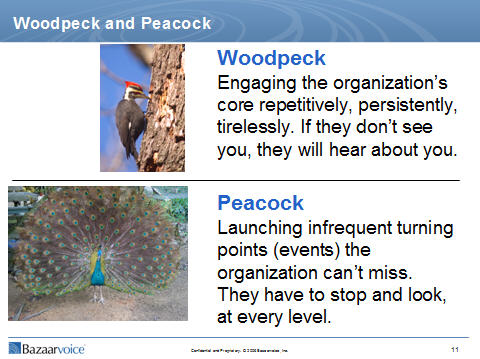
Why? It is really difficult to be in the“boring” web analytics, or any analytics function, and keep our audience, our internal customers, engaged. It is tough to know where the balance is between doing reporting and analysis, between pushing and pulling data. In all this mess how does one drive change? Sam comes to our rescue by providing a brilliant framing of of Woodpecking and Peacocking. Sam tells us that we should have a dual communication strategy. Do “woodpecking” activities such as weekly / monthly dashboards, participating in cross functional teams and be proactive. Essentially be there, in their faces : ), and do it persistently. In addition you should also do “peacocking” activities such as building traditional finance profit and loss statements, doing a/b and multivariate tests that drive improvements in your critical metrics. Essentially activities that are big and make everyone take a pause and take notice, activities that can be case studies that you can use to drive core fundamental changes in your organizations. Sometimes all you need is love, sometimes all you need is someone smart like Sam to provide with such a delightfully easy to understand framework.
Who? Pierre Guillaume Wielezynski, The World Bank
What? Web Analytics: The World Bank Experience (download presentation)
Where? Slide 14, the World Bank’s self developed Buzz Monitor

Why? There were two very impressive things, amongst many, about Pierre’s presentation / job. So many of us, IMHO, are so hard core focussed on solving just for conversion when there is clear, consistent, easily accessible evidence that a small percent of our site traffic comes to “be converted”. Rather than focus on all our customers we focus on and solve for only the customers we want to solve for. The desired customers of the World Bank website are the 150 or so Minister’s of Finance of various countries around the world. The actual users of the website are various public and private sector agencies / companies and the numerous NGO’s around the world (some who agree with the World Bank and others that don’t). In its execution strategy the World Bank solves for all their customers. Key lesson here for all of us. The second very very cool thing was the Buzz Monitor that Pierre has developed. He has taken an open source solution and enhanced it to become an easy to access “dashboard” that tells the World Bank what the latest Buzz is. In the screenshot above, and slide 14 in the presentation, you’ll see “buzz” mined from Technorati and Google Blogsearch (from not just US but non-US sources) as well as Yahoo Terms and User Tags where World Bank buzz is showing up accompanied but a easy to read “buzz trend”. I have had the opportunity to see many commercial, expensive, buzz monitoring solutions, nothing as good as this. Pierre plans to release the improved software bank into open source (and I’ll be waiting anxiously to pounce on it).
Who? John Marshall, ClickTracks
What? Click Fraud Myths and Truths (download presentation)
Where? Slide 5, Click Fraud from Publishers via Google AdSense and Overture Content Match

Why? With all the buzz, that word again : ), around Click Fraud it was disappointing that only 20 odd people were able to attend John’s excellent presentation. I would typically have stayed away from yet another “vendor self hype” presentation but John never disappoints. As you’ll see for yourself this is probably the best presentation on the topic of Click Fraud. It is a systematic dissection of the murky world of click fraud and once you have read this presentation you won’t need anything else (the presentation has examples, practical tips on preventing click fraud and slide 20 tells you how to go about getting a refund) . John’s “vendor hype” indulgence is on slides 25, 26 – you now know and you can ignore them if you want. So the whole thing is good but the one thing that smacked me (and I do feel stupid) was that most of the fraud does not happen on the Google or Yahoo or MSN search results page, rather the largest contributor of fraud is fraud from Publishers, essentially via the AdSense and Overture Content Match programs. In both of these cases crooks put up phony sites with AdSense links and hit those links via robots. These clicks are captured by Google / Overture who then pay out “revenue share” which the crooks get a cut of. Really nice gig.
(Please see my disclaimers and disclosures page.)
My hope is that this best of show summary of reflections is helpful and gives you a glimpse of how wonderful the event is. I would love to get your feedback after you get a chance to review any or all of the presentations above. If you were at the event and attended the above, or any other, presentations then your feedback is also very welcome.
[Like this post? For more posts like this please click here.]













9 thoughts on “Emetrics Summit Reflections: Peacocks, Woodpeckers, World Bank, Lifetime Value & Click Fraud.”
Thanks Avinash! I am happy I met the man behind the blog. Emetrics was indeed very successful, the public sector track was especially interesting for me. I was glad to see public sector agencies really go at it and figure out how best to measure their impact. I certainly learned a lot and, like you, brought home a couple things i will put into practice right away.
Two minor clarifications about my presentation;
> On the buzzmonitor, it is indeed an open source project, not quite ready for release yet but definitely by december. I designed the original specs and we sponsored Development Seed (www.developmentseed.org) to build it around the excellent drupal (drupal.org). More soon!
> I doubt my job would be easier if i had to focus on only 150 customers! Conversion analysis have gotten way too scientific for me! Seriously, serving our clients via an extranet is important but worldbank.org, our main site, is geared towards ngos, government, the private sector, academia, students, researchers and young people. We provide data sets, research papers, projects databases, publications etc…hence the extensive us of metadata in our reporting.
Thanks for sharing this Avinash. Couldn’t make it to the eMetrics Summitt and have been trolling for information.
Thanks Avinash! Great info, unfortunetely I could’t be there for work reasons so at least this gives me an overall vision of what happend there.
May I provide that info to my blog readers?
Thanks in advance
Juan
Hi Avinash,
In regards to the John Marshall’s click fraud presentation…did he talk at all about the recent Business Week investigation on click fraud? Click fraud was the cover story on the October 2nd, 2006 issue called: “Click Fraud: The Dark Side Of Advertising”
It spoke about what they call “parked web sites” or web sites with little or no content except for lists if Internet ads, often supplied by Google or Yahoo; many of them are the source of false clicks.
It was an extremely shocking issue. They investigated a guy in Budapest who owns as many as 200 parked sites. He claims to take in $7,000 a month because he recruits members who agree to read marketing emails and web sites. He pays these readers about a penny for every click they make. He receives a bunch of money from search engines like Google and Yahoo because he owns these parked sites and generates clicks for them. Even though most of these clicks are bogus, he still gets paid!
The issue gave Google and Yahoo a bad name in my opinion.
Avinash,
Thanks for the great recap!
Jonathan
Many people are surprised by the sophistication of the click fraud networks that use both automated bots and armies of low cost labor. However, to me it’s even more surprising that advertisers are not more diligent about tracking their spend. It’s false to assume the networks (Google, YSM, MSN etc.) are going to stop it. It’s the responsbility of the advertiser to stay on top of their data.
It’s also important to note that a significant amount of supposed click fraud is not that at all, but simply poorly targeted advertising. I did cover this in my presentation of course, but it’s worth higlighting here that the traits that expose click fraud also highlight wasted advertising dollars. An advertiser can save a lot of money either way.
The key to detecting click fraud is to avoid looking at ROI. If you look at ROI you’re attempting to use the lack of something (conversions) to prove the existence of something else. Tricky, because ROI often doesn’t show up for a majority of campaigns, even without click fraud. Instead you want to use the presence of certain traits, like very short Average Time On Site. We’re writing a step by step approach to click fraud that will be published soon. Some of the steps are specific to ClickTracks’ products, but can adapted to anything else pretty easily.
A preview of the article is here (it will undergo further editing)
https://www.clicktracks.com/insidetrack/articles/click_fraud_how-to_1.php
Pages 2 and 3 are probably most interesting.
John M.
Pingback: eMetrics Summit - Washington 2006 : A big thank you to you all! « WebAnalytics.be Blog
Thank you Avinash! You deliver a great tribute to the WA market. I’m in Web Analytics in the Dutch market and read your posts with great interest.
Cheers,
Jethro
Pingback: Web Analytics Facts » Emetrics summit overview